
For most factories and manufacturing units in Gujarat, electricity is not a minor overhead; it can account for 15 to 30 percent of total operating costs. In sectors like textiles, pharmaceuticals, chemicals, ceramics, and engineering, where margins are always being squeezed, that is a significant number. Rooftop solar has become a practical way for industrial businesses to bring that number down, and the adoption rate across Gujarat’s industrial corridors has been accelerating sharply.
Choosing the right industrial rooftop solar company to handle a project is a more consequential decision than most business owners initially appreciate. A factory-scale solar installation is a multi-crore investment that needs to perform reliably for 25 years. The company you pick determines almost everything about whether that happens.
How quickly industrial solar has grown in India
India installed 3.2 GW of rooftop solar in 2024, with the commercial and industrial solar installation segment contributing around 19 percent of that figure. India’s total rooftop solar capacity is expected to grow from 17 GW in FY2025 to 30 GW by FY2027, according to JMK Research, with the industrial and commercial segments being a major driver of that growth.
Gujarat is at the centre of this. The state accounted for approximately 36 percent of India’s rooftop solar additions in 2024, the highest of any state, with manufacturing and industrial units contributing a large share. For businesses operating in Ahmedabad, Surat, Rajkot, Vadodara, and across Gujarat’s industrial zones, the question is no longer whether to go solar. It is which industrial solar installation company in Ahmedabad and across Gujarat can be trusted with the project?
The financial case for industrial solar
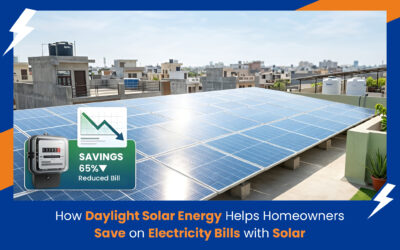
The numbers for solar power systems for factories in India are clear. Factories and manufacturing units that have installed rooftop solar systems have seen electricity bill reductions of 60 to 80 percent on daytime consumption. For a factory spending Rs. 20 lakh per month on electricity, that is a potential saving of Rs. 12 lakh to Rs. 16 lakh every month after the system pays for itself in 3 to 5 years; those savings accumulate as direct returns on the capital invested.
Beyond the electricity bill, industrial businesses can claim accelerated depreciation under Section 32 of the Income Tax Act up to 40 percent on solar plant and machinery in the first year. For profitable industrial units with a tax liability, this can meaningfully reduce the effective cost of the installation and shorten the payback period. The payback period for industrial solar in India typically falls between 3 and 5 years when accounting for system costs, O&M expenses, and realistic generation estimates.
Why choosing the right EPC company matters
An industrial solar EPC company handles the full scope of a project, Engineering, Procurement, and Construction, from the initial site assessment and system design through equipment procurement, civil and electrical work, grid connection, and commissioning. For an industrial client, the EPC company’s capability determines everything: whether the system is sized correctly for the facility’s load, whether the equipment is genuine and warranted, whether the civil work meets structural requirements, and whether the project is completed on schedule without disrupting operations.
Industrial solar projects are more complex than residential ones. Higher voltage DC systems, larger arrays requiring careful wiring design, industrial-grade electrical safety standards, and DISCOM coordination for higher-capacity grid connections all require experience and engineering knowledge. An EPC company that has primarily done residential work will have gaps in all of these areas.
Daylight Solar Energy’s experience in industrial projects
As a trusted industrial solar project company Gujarat, Daylight Solar Energy has completed projects across factories, warehouses, manufacturing units, and commercial complexes. The team brings both engineering design capability and hands-on installation experience across a range of system sizes and industrial building types. The ability to design correctly and then execute that design properly is what industrial clients consistently identify as the key difference between a capable EPC company and one that can only do one or the other.
Projects are managed with clear milestone timelines, regular updates to the client, and documentation at each stage. Industrial businesses cannot afford unexpected delays that affect production schedules. Daylight Solar builds its project execution around minimising disruption to operations during the installation period.
Designing systems for large industrial facilities
Large scale rooftop solar installation for industrial facilities typically covers large roof areas that can support systems from 50 kW to several megawatts. At these scales, the system design involves multi-string configurations, central or multiple string inverters, DC combiner boxes, and sometimes battery storage for load shifting. As a full-service solar energy provider for industries, Daylight Solar designs these systems to match the facility’s load profile, the pattern of electricity use through the working day, so that solar generation offsets maximum grid import during peak tariff hours.
For factories with continuous operations, including night shifts, the solar design focuses on full daytime offset. For businesses that run single or double shifts during daylight hours, a larger system that generates more than the facility uses immediately and exports the surplus through net metering may work better. These decisions require a detailed energy audit and load analysis that Daylight Solar conducts at the start of every industrial project.
Equipment for industrial-scale solar
Industrial solar panels used in these projects benefit from higher efficiency because the same roof area generates more electricity. Daylight Solar works with panels in the 400 to 540 Wp range, including monocrystalline PERC and TOPCon technology modules, which offer efficiency of 21 to 23 percent compared to 16 to 18 percent for standard panels from five years ago. Higher efficiency is particularly valuable for factories where roof space is constrained by skylights, HVAC units, or structural limits.
Industrial-grade inverters with IP65 or higher protection ratings are specified for factory environments where heat, vibration, and airborne particles are higher than in residential settings. The electrical design also incorporates surge protection, DC isolation devices, and grounding systems that meet Bureau of Indian Standards requirements for rooftop solar solutions for industries on commercial and industrial premises.
Return on investment: the numbers
At a commercial tariff of Rs. 8 per unit, a 200 kW system generating approximately 8 lakh units per year saves around Rs. 64 lakh annually. At that saving rate, a system costing Rs. 1.2 crore pays for itself in under two years. Commercial tariffs in Gujarat typically run between Rs. 7 and Rs. 10 per unit, depending on the DISCOM and consumption slab, which makes industrial solar power solutions more financially compelling than rooftop solar in the residential sector.
The 20-plus years of generation that follow payback represent a period of very low-cost electricity that gives the business a structural cost advantage over competitors still paying full grid tariff rates.
Safety standards and project documentation
Factory rooftop solar installation carries higher safety stakes than residential projects. Higher voltage DC systems, larger current flows, and the proximity of live equipment to factory operations all require strict safety protocols. Daylight Solar’s industrial installation teams follow documented safety procedures, use appropriately rated protective equipment, and adhere to IS 16169 and relevant IEC standards for the components installed.
Project documentation includes single-line diagrams, as-built drawings, equipment test certificates, and commissioning reports. These documents are needed for DISCOM approval, for insurance purposes, and for any future expansion or modification of the system. Businesses that receive complete project documentation at handover are protected against ambiguity if questions arise later.
Long-term O&M and support
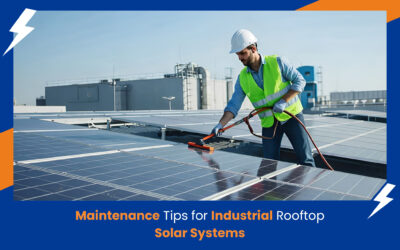
Daylight Solar provides O&M services as part of its comprehensive solar energy solutions for manufacturing units and the industrial projects it completes. This includes quarterly cleaning, semi-annual electrical inspections, annual thermographic scans, inverter servicing, and continuous performance monitoring. Industrial clients receive periodic generation reports that track actual output against expected output, making it straightforward to identify when the system needs attention.
Long-term service support matters more for industrial installations than for households because the consequences of an extended outage are more significant. A factory that loses its solar generation for a week during summer goes back to paying full grid rates during peak demand. Daylight Solar’s industrial support structure is built around rapid response and proactive monitoring that catches issues before they cause prolonged output losses.




0 Comments